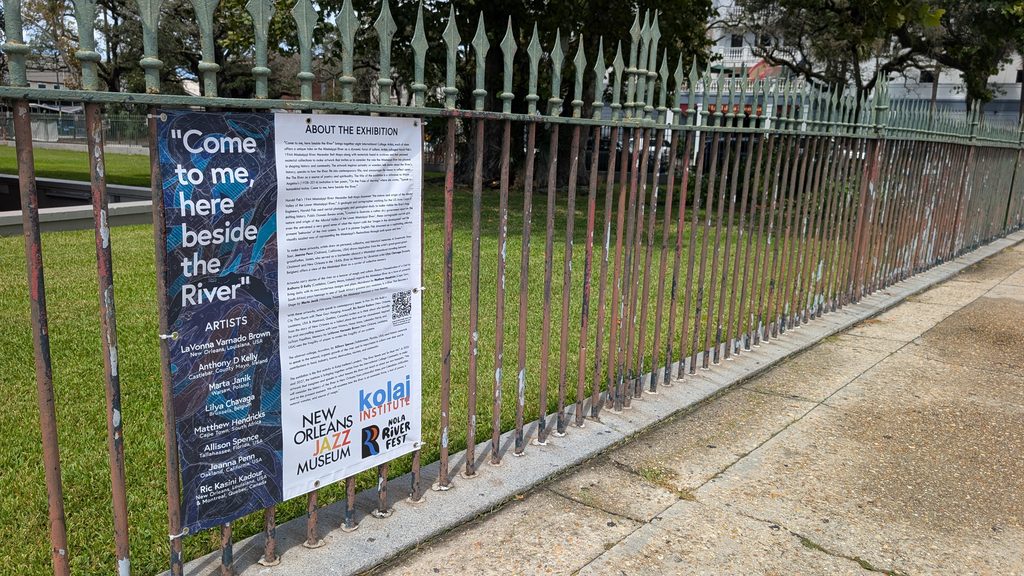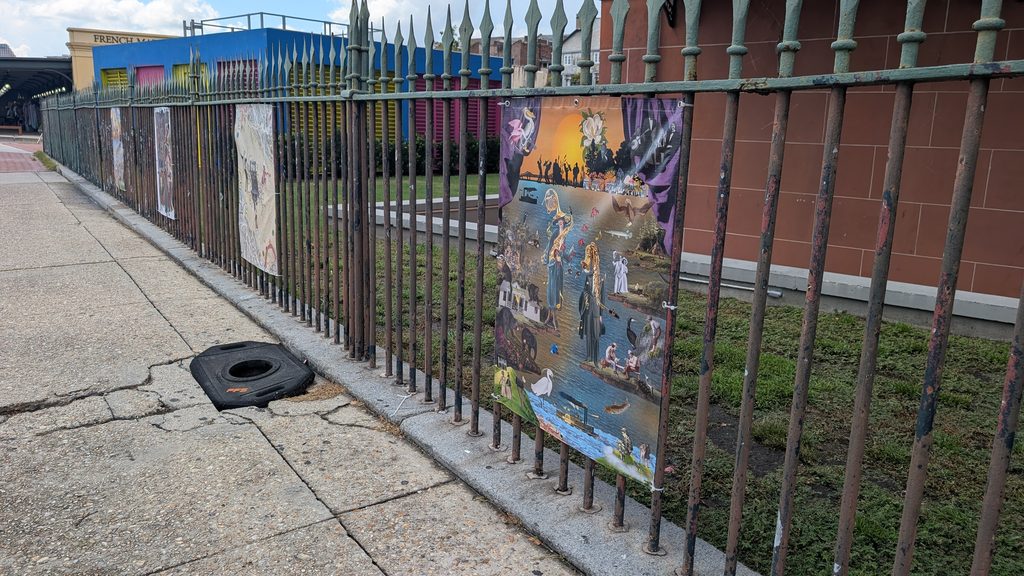
“Come to me, here beside the River” – the exhibition brings together nine collage artists from around the world. Each of them presented their own unique vision of the River Mississippi. The exhibition took place from 8 to 22 September 2026 on the iron fence of the New Orleans Jazz Museum.
Artists taking part in the project:
Anthony D Kelly (Castlebar, County Mayo, Ireland)
LaVonna Varnado Brown (New Orleans, Louisiana, USA)
Marta Janik (Warsaw, Poland)
Lilya Chavaga (Brussels, Belgium)
Matthew Hendricks (Cape Town, South Africa)
Allison Spence (Tallahassee, Florida)
Seth Ter Haar (New Orleans, Louisiana, USA)
Jeanna Penn (Oakland, California, USA)
The exhibition is the part of the KOLAJ INSTITUTE project ‘The River Bends and So Must We’, which explores the Mississippi River as a dynamic cultural force. In 2026 and 2027, the KOLAJ INSTITUTE is bringing together artists from the International Collage Community to create works of art that imagine and explore the lessons this river can teach us about our humanity. Throughout the project, we are examining the history of the river in New Orleans from ancient times, through pre-Columbian civilisation, right up to the present day. We are exploring how the river serves as an economic force, an instrument of power, a natural wonder and a source of magic. We are responding to the invitation from Maya Angelou (1928–2014) in her poem, “On the Pulse of Morning”, and “Speak to humankind today. Come to me, here beside the River.”
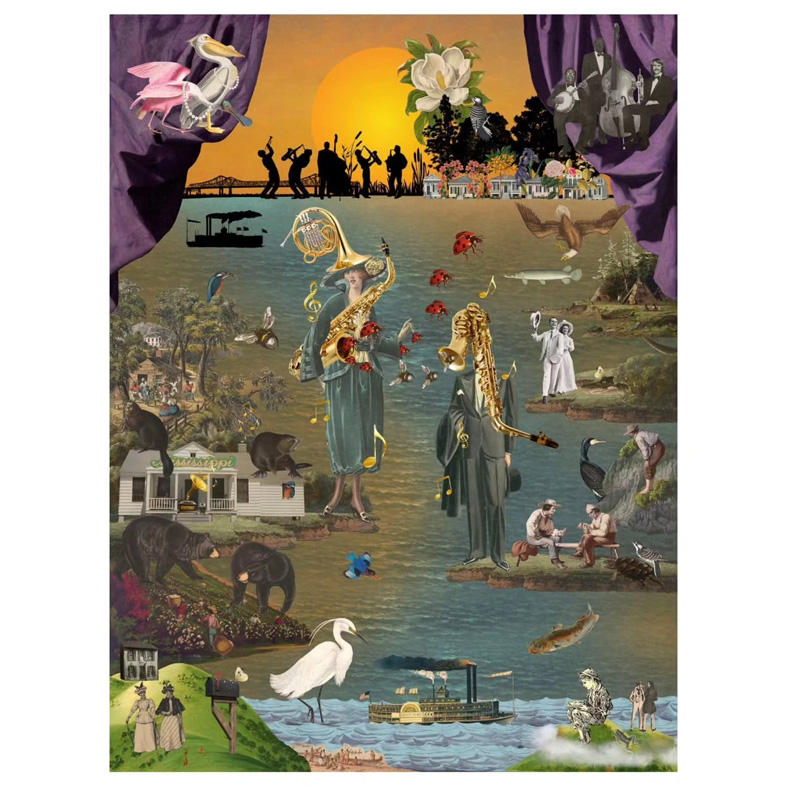
Here are a few words about my collage and what was going through my mind as I was creating it.
A River That Becomes a Stage
It all begins and it all began with a boy reading a book. The cut-out figure comes from the first edition of Mark Twain’s Life on the Mississippi, published in 1883 — a book in which the Mississippi is more than a setting: it is a character in its own right.
“In time, the surface of the water became a magnificent book… And it was not a book you read once and then set aside, for every day it had a new story to tell.”
The journey begins with the boy reading. The open book becomes the source of the river, and the river becomes a stage on which images, characters and stories unfold. What lies within the pages begins to spill beyond their borders. Literature merges with reality, reality with imagination, and history with fiction.
Wooden houses, Native American villages, cotton pickers and steamboats appear along the river — fragments of the history and life of the Mississippi. Among them is a young Mark Twain, transformed from an observer of the river into a protagonist in his own story. The collage also features the house where he grew up.
Alongside the human world, a vast natural landscape unfolds. Pelicans, roseate spoonbills, herons, kingfishers, cormorants, bald eagles and other birds circle above the water. Catfish and alligator gars swim beneath the surface, while beavers, turtles and bears inhabit the riverbanks. Cattails, magnolias, irises, hibiscus, azaleas and camellias grow among the oaks lining the shore.
Music flows with the river, too. Jazz musicians, musical notes and instruments evoke New Orleans, where the Mississippi meets one of America’s great musical traditions. Two surreal figures steal human hearts and transform them into musical instruments. Music becomes another protagonist in the collage, spreading across the scene in a tangle of notes that follows the course of the river.
The collage does not reconstruct a single place or moment in time. Instead, it brings together things that reality keeps apart — across time, space and history. This is what I love about collage: its ability to bring disparate elements together and create unexpected connections. Here, the Mississippi becomes a place where the past coexists with the present, literature with nature, and real landscapes with fragments of imagined worlds.
At the bottom of the collage, I have placed a small, seemingly ordinary object: a letterbox with its flag raised. Someone is waiting for a message. Is it Mark Twain? Is it me, the artist? Or is it you? In this world, the next story could arrive from anywhere — from a book, from the river, from the past, or from somewhere we have yet to discover.