

The “Migracje/Migration” exhibition was my first experience taking the lead as a curator. This opportunity was all thanks to the talented festival organiser Caroline Conway and the Birr Vintage Week & Arts Festival, Ireland. I had a fantastic experience in Birr during the festivals 2021 edition while working on the “Empty Columns Are A Place To Dream” exhibition curated by Ric Kasini Kadour. So once the 2021 festival wrapped up, I kept in touch with Caroline Conway and we decided that we would like to collaborate together on further projects. During our conversations, I proposed a potential collage exhibition around the theme of “Migrations”. At the time this theme was relevant to our shared national histories and contemporary social struggles.
But this was late 2021, and we did not yet know that Russia would take the fateful decision to brutally attack and invade their neighbouring country of Ukraine that following February. Once this occurred, many people would once again be forced to flee their homes, to escape a devastating war, and our chosen theme of “Migrations” took on an even more present and vital meaning. The exhibition itself gathered collage artists from different countries including Ukraine, and invited them to reflect on their personal experiences around the theme of “migration”.
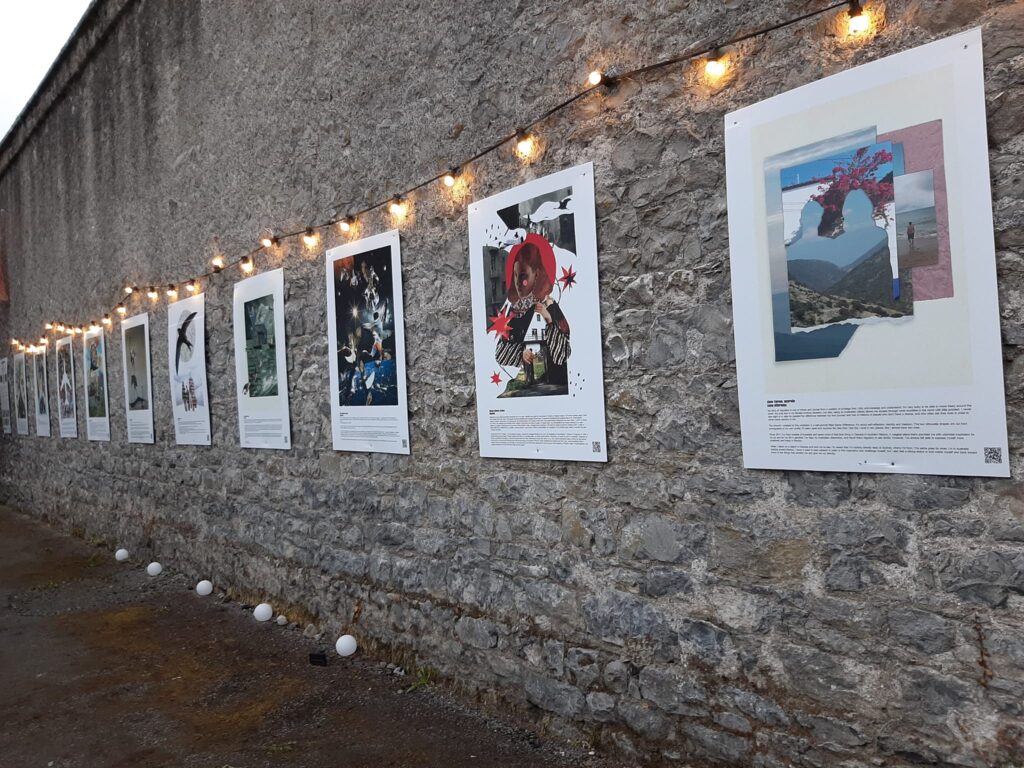
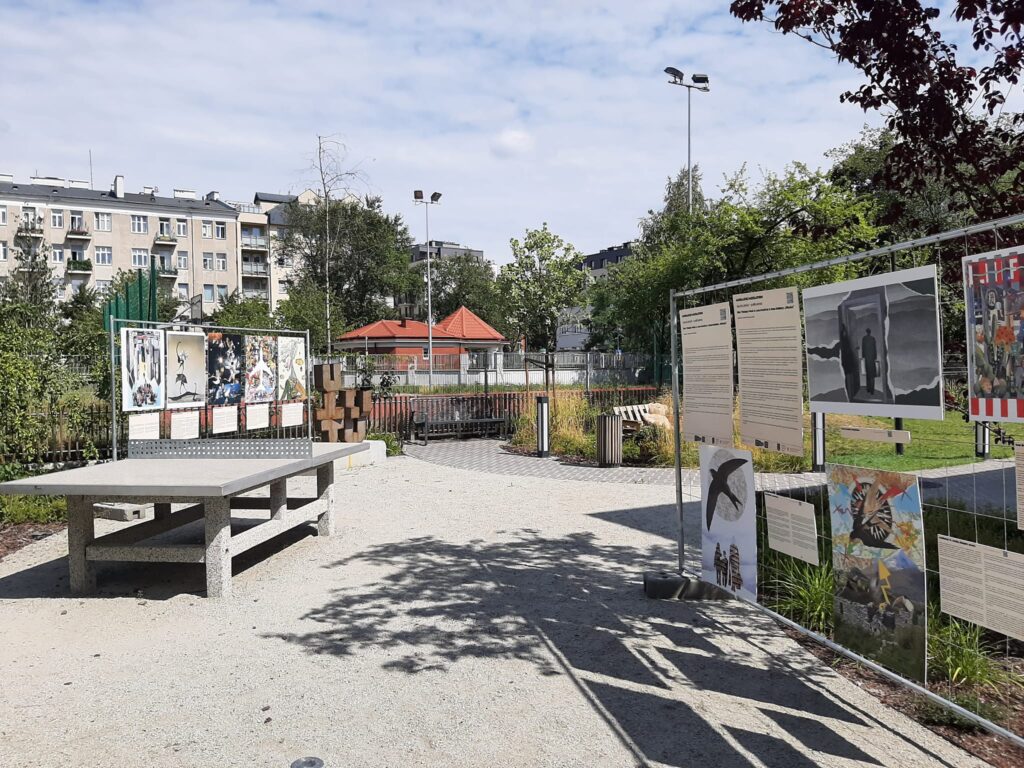
The resulting collages were then exhibited during a dual exhibition which took place simultaneously at both the 54th Birr Vintage Week & Arts Festival Birr, Ireland and the Praga Cultural Center, Praga-Północ, Warsaw, on the grounds of the Konopacki Palace from July 29th to August 7th, 2022.
Participating Artists, whom I invited to the project:
Lou Beach (USA)
Jerome Bertrand (Canada)
Yuliia Fareniuk (Ukraine)
Maria Filek (Poland)
Una Gildea (Ireland)
Domenico Goi (Italy)
Anthony D. Kelly (Ireland)
Denis Kollasch (Germany)
Sherry Parker (USA)
Silvio Severino (Brazil)
Maryna Siliakova (Ukraine)
Steve Tierney (Australia)
Tanja Ulbrich (Spain)
The project was supported by The Arts Council of Ireland, The Creative Ireland Program, Offaly County Council and the Irish Embassy in Poland.
Here is the press release I wrote from July 2022:
“Since February 24, the eyes of the world have been on Ukraine, which was brutally attacked by Russia on that day. Already more than 12 million Ukrainian citizens have left their homeland to flee the war to other countries, the UN refugee agency reported in early July. The history of the world is the history of migration. This phenomenon is increasingly affecting each and every one of us, in almost every corner of the Earth. People migrate for many reasons: in search of peace, security, but also to earn better money, to live better. They are forced to do so by the political, economic, increasingly climatic situation. Some set out because they are simply looking for themselves and their place on earth. But, after all, it is not only humans who migrate. Animals and plants also migrate. Some birds can travel a distance of up to ten thousand kilometres. One milkweed seed can be carried by the wind for several kilometers! Collage seems to be the best technique for showing the experience of migration, an art metaphor for it. Through migration, our countries become a collage. But not only they, we too are a collage. We who live with migrants, but also we migrants.
We are composed of different experiences and histories. There are new problems, new challenges. We learn, we pose questions. What does it mean to be at home? What does it mean to be a stranger? What does the word “homeland” mean? Random elements appear in our lives, from which we build meanings. Like in a collage. And from there it’s only a step to the migration, which is, after all, made by each of us. Migration to one’s inner self. It is a journey that is unique and most personal.”
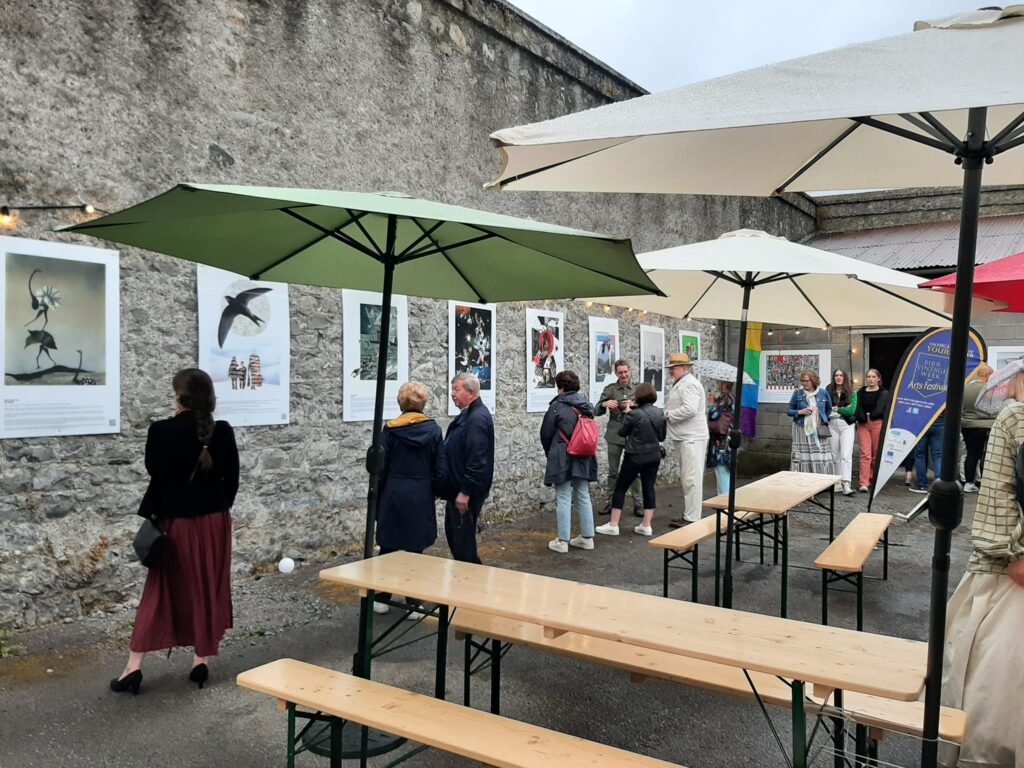
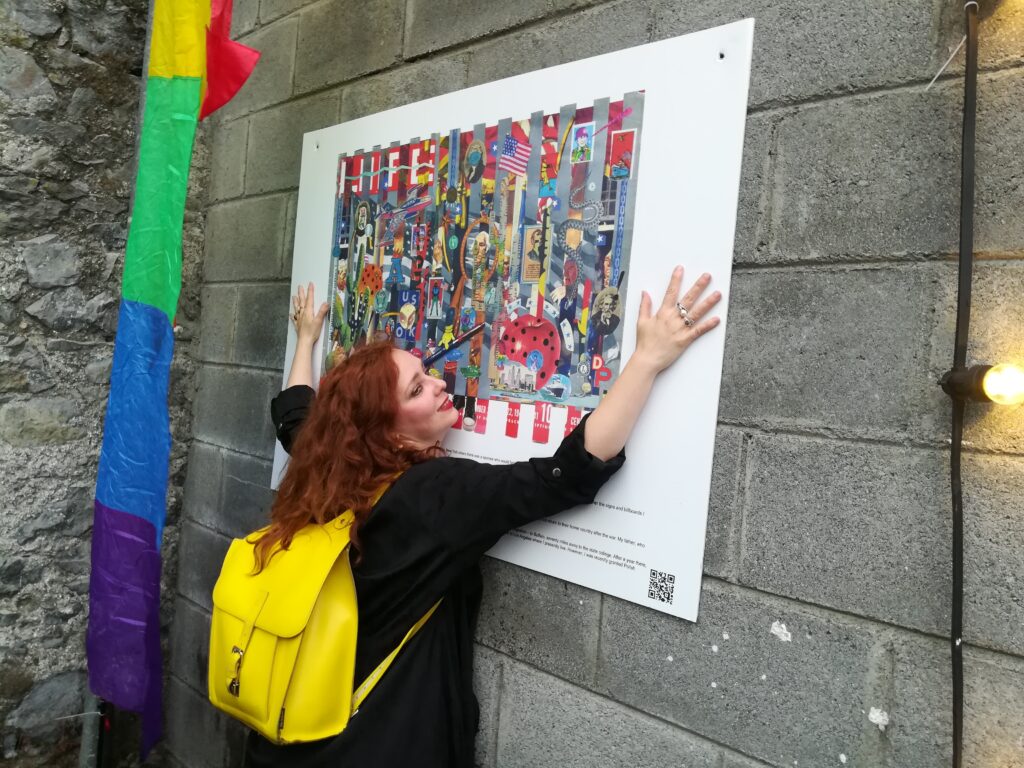
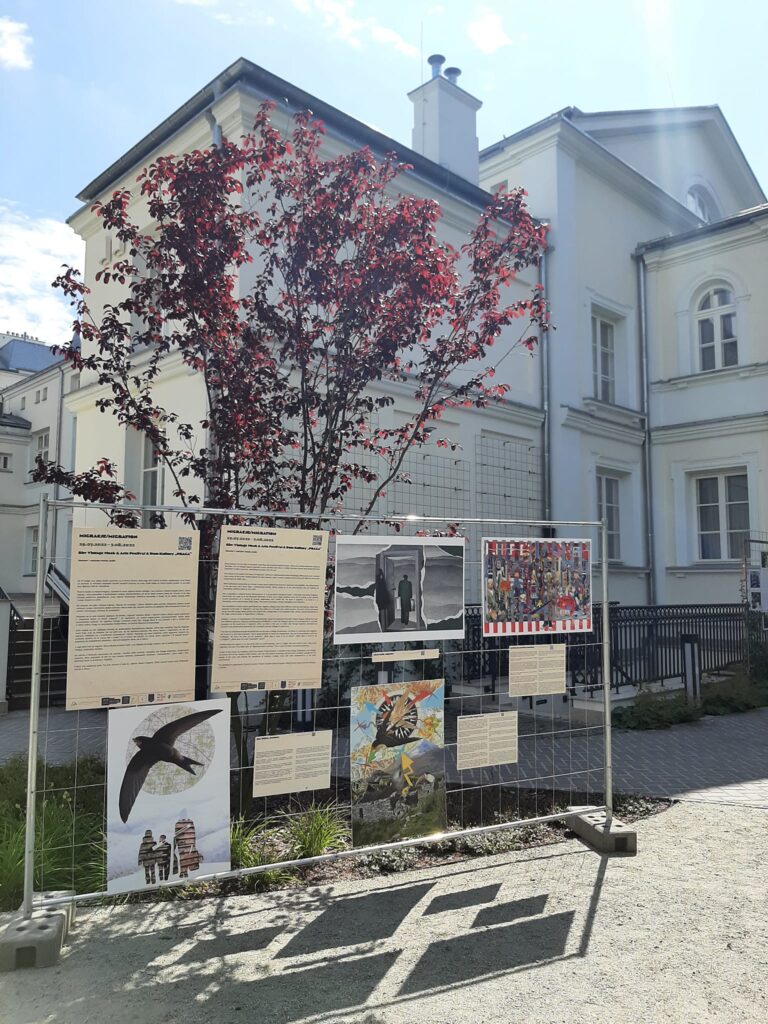
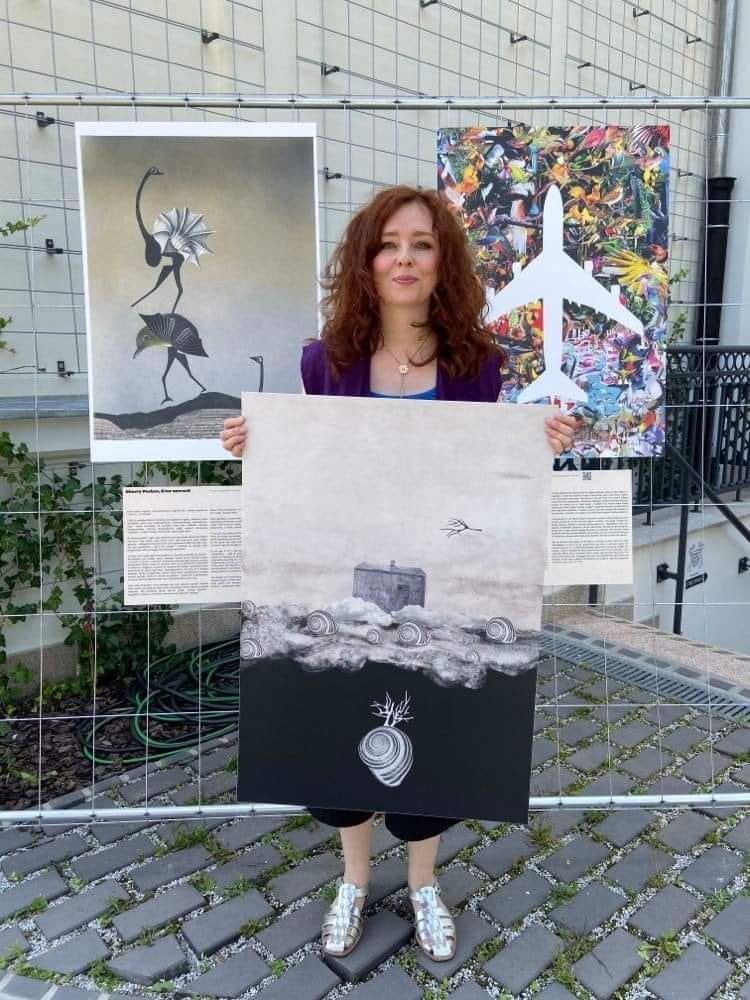
Me in front of the Konopacki Palace in Warsaw district Praga-Północ, holding a collage by Domenico Goya; behind me you can see the collages by Sherry Parker and Jerome Bertrand.
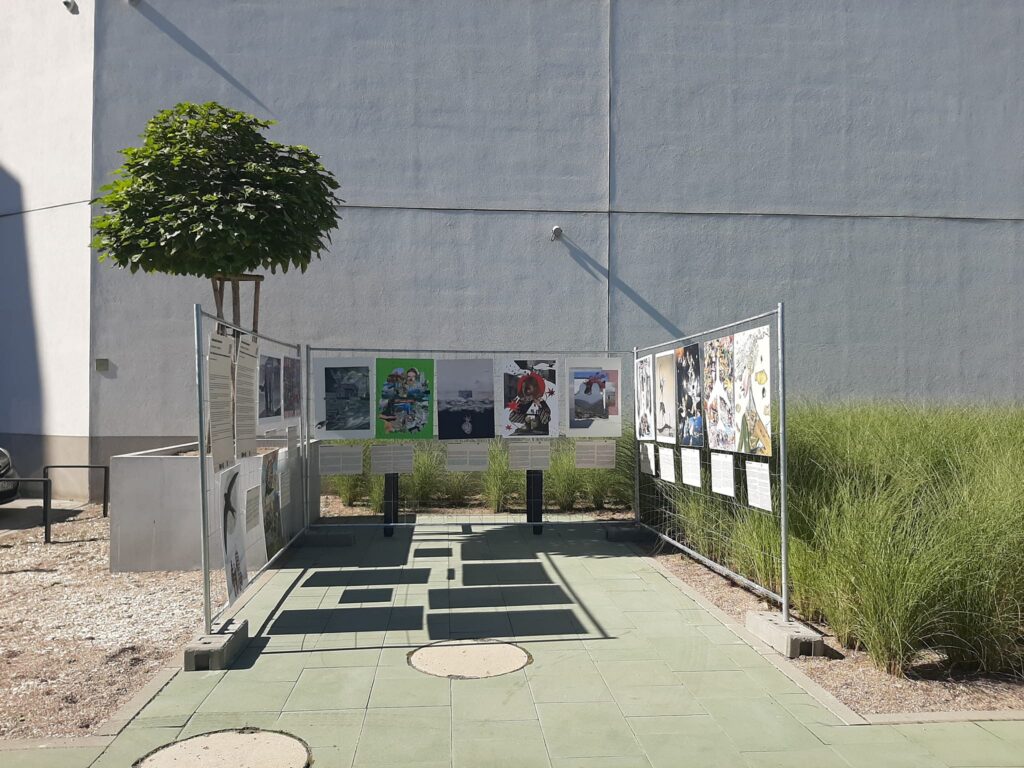
The exhibition was also held at the Różyckiego Market (Różyc) at the back of the Praga Museum of Warsaw.
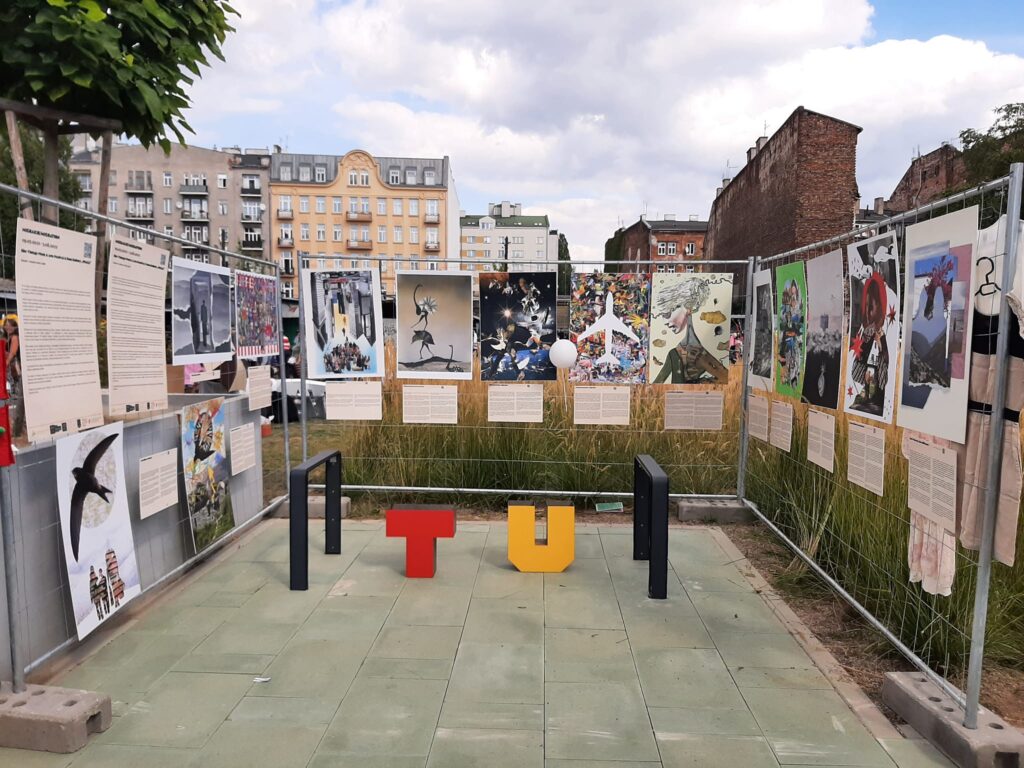
Różyckiego Market (Różyc)
PRACE ARTYSTÓW
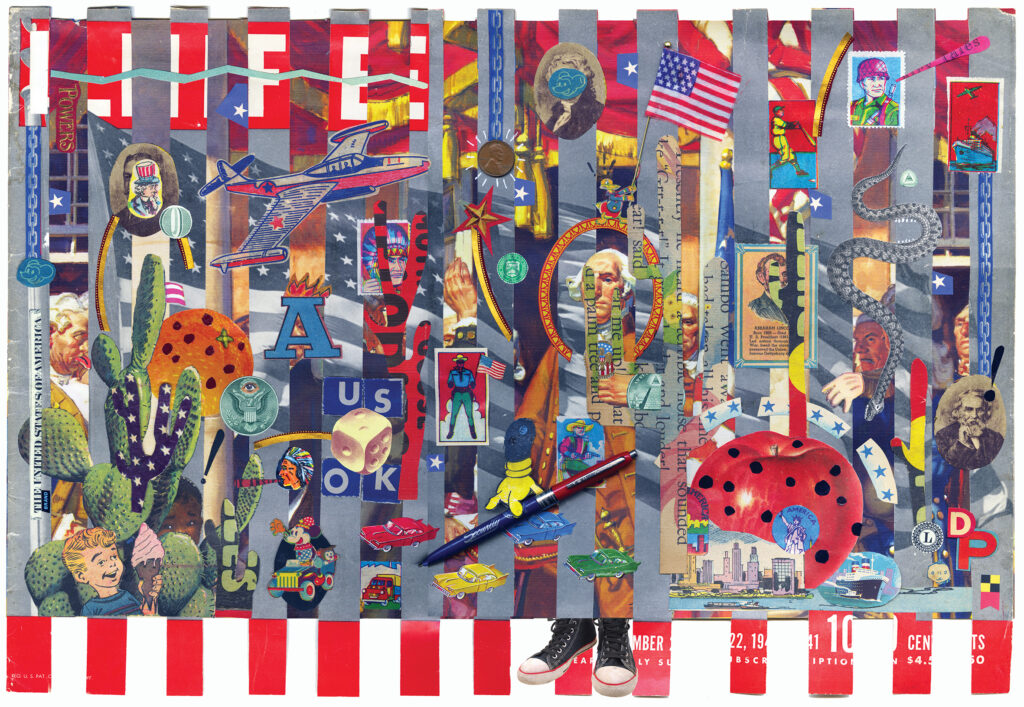
Lou Beach
“I am an immigrant.
I was only four years old when after a long and harrowing sea voyage, my family and I landed in New York City. Shortly thereafter, we moved to Rochester, New York where there was a sponsor who would help us integrate into life in our new country.
Mickey Mouse! Coca Cola! Cowboys! Indians! Big cars! TV! Skyscrapers! Hamburgers!
Although our emigration from Europe happened decades ago, I can clearly recall the feeling of being someone “other” in our new home in the US. I did not speak the language that my classmates spoke in the pre-kindergarten class I attended. I could not decipher the signs and billboards I saw, or read anything else that was in English. My mother wanted us to only speak Polish at home, while my father and I would secretly try to converse in English – we wanted to be Americans!
Mickey Mouse! Coca Cola! Cowboys! Indians! Big cars! TV! Skyscrapers! Hamburgers!
There were people in our neighborhood, a Polish-American enclave with streets named Warsaw and Pulaski and Kosciusko, who were not welcoming, who called us “dirty DPs”. A DP was a Displaced Person, someone who could not return to their home country after the war. My father, who had fought the Russians as well as the Nazis, would have been imprisoned had he returned to Communist-ruled Poland.
My parents worked hard and prospered and we integrated into the social fabric of Rochester, moving out of the old Polish neighborhood. I attended high school and community college and then made my second migration – to Buffalo, seventy miles away to the state college. After a year there, the next step was to travel to Los Angeles where I lived for a number of years until I decided to go to Boston, ostensibly on the way to Europe, but I stayed in Massachusetts instead for several years, then back to Los Angeles where I presently live. However, I was recently granted Polish citizenship, so my missed trip to Europe may finally happen. I can be an immigrant there!”
Jerome Bertrand
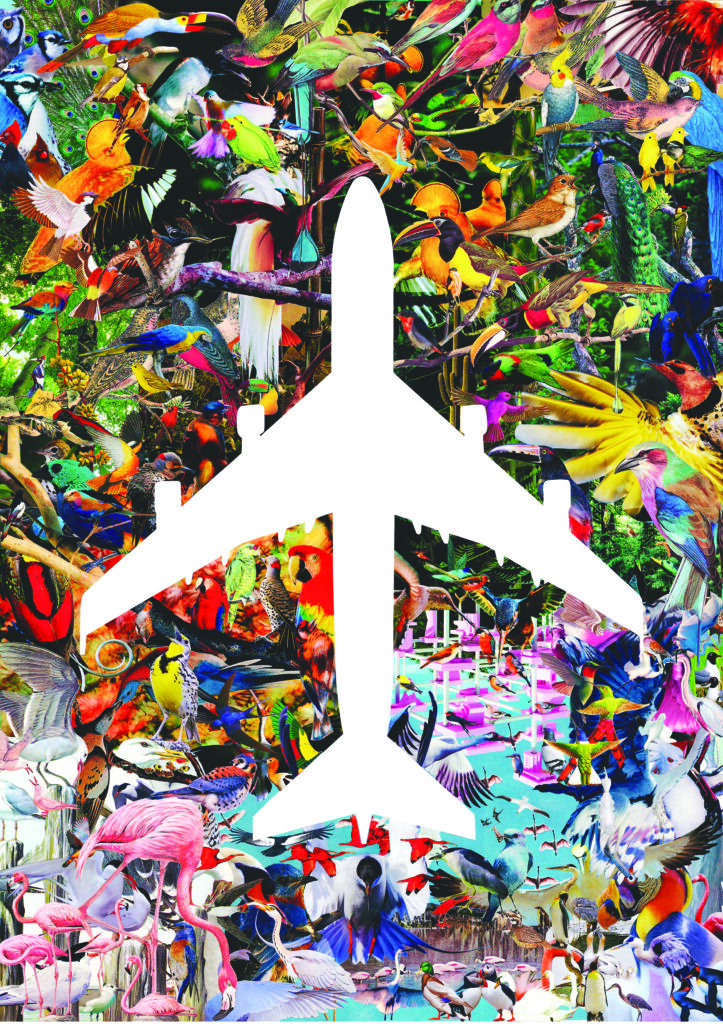
“I readily agreed when Marta asked if I might compose a piece on the subject of migration. I ventured outside to relax. It was spring, and I heard birds singing once more while observing a few planes in the sky. Why not create a collage using those two components, I reasoned. Migration entails movement. Mostly, though not mainly, via air. How would I combine the human-made flying devices with birds’ inherent ability to glide? I made the decision to experiment with scale and multiplicity. I created a series of all-over collages with images of cars last year. I wanted to do it again, but with birds because I really enjoyed it.
I had planned to use these unique creatures to create a plane shape, but the reverse turned out to be the best course of action. The white cardboard’s empty expanse seemed to belong exactly where it is. Thoughtless, bold and graphic, nonetheless. Because it can be read so fast, the idea of addressing the public with a large, almost signage-like plane is intriguing. The intricate frame envelope may then be appreciated in great detail. We can marvel at the beauty of these tiny creatures who travel great distances to keep up with the season.
We, as humans, also appear to be able to relocate to places that are most advantageous in terms of our loved ones, our jobs, or perhaps where our intuition leads us to a creative blossoming. Apart from moving to a larger city nearby, I haven’t changed my base camp around much. One of Canada’s most culturally diverse cities, Montreal invites visitors from all over the world. This gives us the opportunity to engage with local communities through events and festivals, which helps us better comprehend the range of ways that people as a species might experience life.”
Yuliia Fareniuk
“My migration started with the beginning of the war in Ukraine. That morning I opened my eyes with the clear understanding that a great catastrophe happened and that past was destroyed. War forced me to make changes. There were things to do. One was to stay in the flat and to wait for news from the government, another was to take my bag and to move to a safer place.
I chose to move and that is how I started to migrate. As my heart was full of angriness towards the aggressor, I left with one heavy bag, in which I had packed all my life that was in my mother’s home near the forest. After the second day we went to the railway station and then to Warsaw. It was a long and dangerous road with many people in the same situation: we had all lost our homes.
In Warsaw we decided to go farther. We chose Ireland because it is an island, a place which, in my opinion, is the safest in the world. After spending one night at the airport, I arrived in Ireland on a sunny morning. But I was afraid to encounter accommodation or food problems.
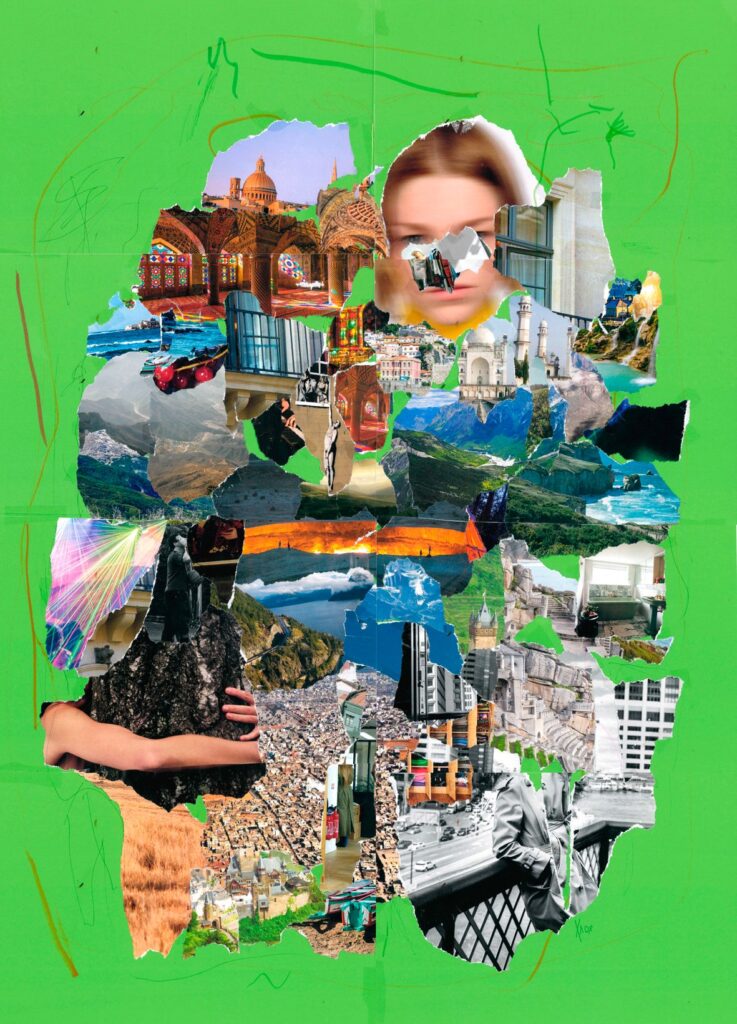
For the exhibition “Migration”, I have created a collage in which I handle the topic of exploring life. To me, the migration results from of a great desire to live. I have tried to express life’s energy, the way life calls you while your well-being is at stake because of challenging feelings. Indeed, my experience has taught me that the feeling of insecurity haunts you even when you are safe. A new place to live gives a lot of expectations. Over the first months you discover a wonderful shelter. During this period you think about your home and your native land, you can’t stop comparing them to your new place. The best thing that I could say was: “This place is like Kyiv!”
My collage consists in four parts and a central part showing The Gates of Hell – it’s a nature miracle in Tajikistan. The first part, on the top left, tells about the situation of danger and explains why life is so beautiful. I have used a fragment of Banksy’s work in Birmingham.
The second part – also on the top left – shows worries and expectations. In all parts of my collage, I use the window as a symbol of openness to new invitations which constitute your days.
The third part – on the bottom left corner – relates to the basis of our personality, which has evolved in our native city and shapes our inner ability to look for the bright sides of life.
The fourth part – on the bottom right corner – is the most melancholic part, because migration is a transition to something new that is not related to the past. And because in order to keep a clear perception of the extreme changes that happened in your life, you need to grow the love required to live on a daily basis.”
Maria Filek
“When everything fails, radical solutions are sometimes required to get away from a difficult situation. Then the thought of migration may arise. Yes ! Leave, leave, run away! As far as possible. However, not everyone has the courage to tear up roots and to go away. Obviously, every place where we are not can seem wonderful. Yet, migration is not always a way to escape. It is often our curiosity that encourages us to wander in search of new, friendly places, previously imagined as such. So here we go!
Among the many types of migration, the internal migration is the most mysterious and intimate. “Thinking”, “daydreaming”, “swinging in the clouds,” in a word, dreaming – is a state that allows you to wander deeply into yourself. It is a human need for isolation from tiring reality. Then we forget about our present situation and wander in the recesses of the soul, opening the drawers of thoughts, recreating the tapes of events, wiping away dusty feelings, laboriously untangling the knots of bad thoughts. We cleanse our head as well as our heart.
Creating collages can be compared to a laborious journey through the world of fantasies, associations, or through a specific theater of events. In order to create a collage, you need to collect interesting and peculiar materials that, when combined, create a new image and convey an idea, providing a unique form.
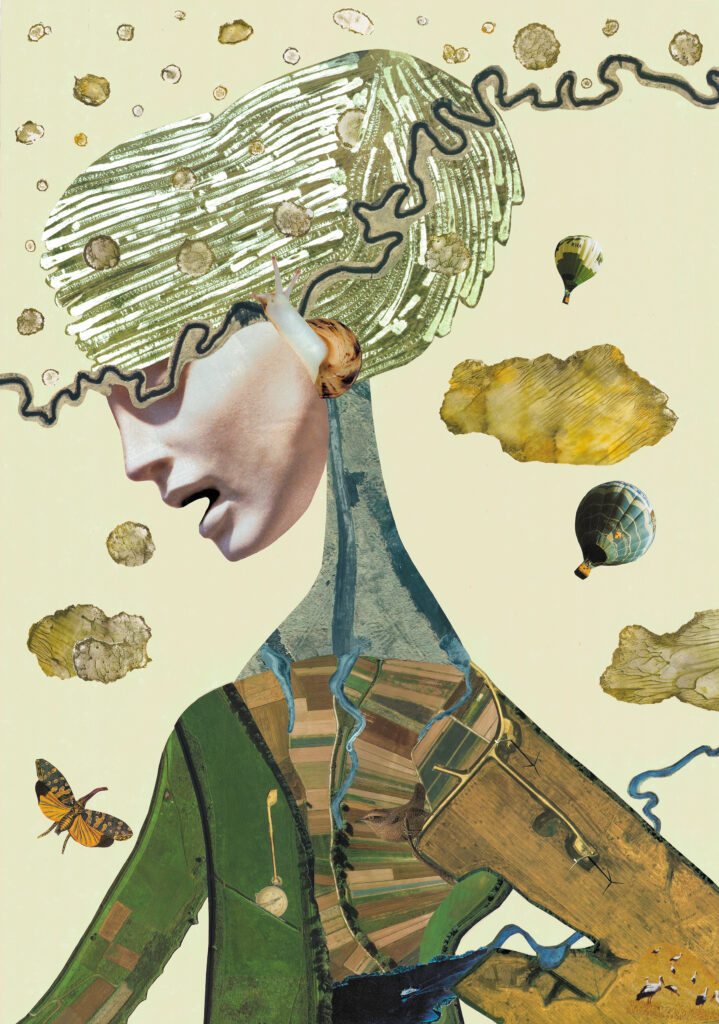
The collage displayed consists in thoughts related to travels. There is such a temptation to go wherever everyone has already been. Everywhere, meaning where? Apart from the mundane limitations, we can always wander the paths of our sensitive soul and discover non-material beauty in the broadest sense. These thoughts are in our head on a constant journey. They can break free and swim with the current, soar like birds, roll slowly like a snail and come back.
The collage includes photos of Poland from a bird’s eye view. Plowed and fertilized agricultural areas on the part of the head were deliberately used – this is an allusion to the constant need to enrich the mind. The meanders of a river over the head symbolically divide the collage’s composition into a part representing the internal migration at the top and the real migration at the bottom. From the central head, streams of water flow down the neck to give life to the earth that nourishes us as well as the visitors. You can see the windmills that are propelling energy by the wind force. There are also storks – our Polish storks, which invariably come back to us year after year in the spring, arousing hope in people’s hearts. A compass placed in a vest made of forests and green meadows will not let you get lost. There is also an offer to travel in a balloon – it will deliver an extraordinary experience and help to broaden the horizon. Green and yellow ovals are thoughts – both light and heavy. This is a handmade collage.”
Una Gildea
“I emigrated from Ireland in 1988. I left and went to Greece and lived in Athens. It was my choice. Yes, there was a recession in Ireland at the time and work prospects were limited, but this wasn’t my reason for emigrating. I just wanted to leave Ireland, to live and work somewhere else. After a year in Athens I left and went to live in Holland, first in Arnhem and then in Amsterdam. I lived there for 14 years, returning to Ireland in 2004.
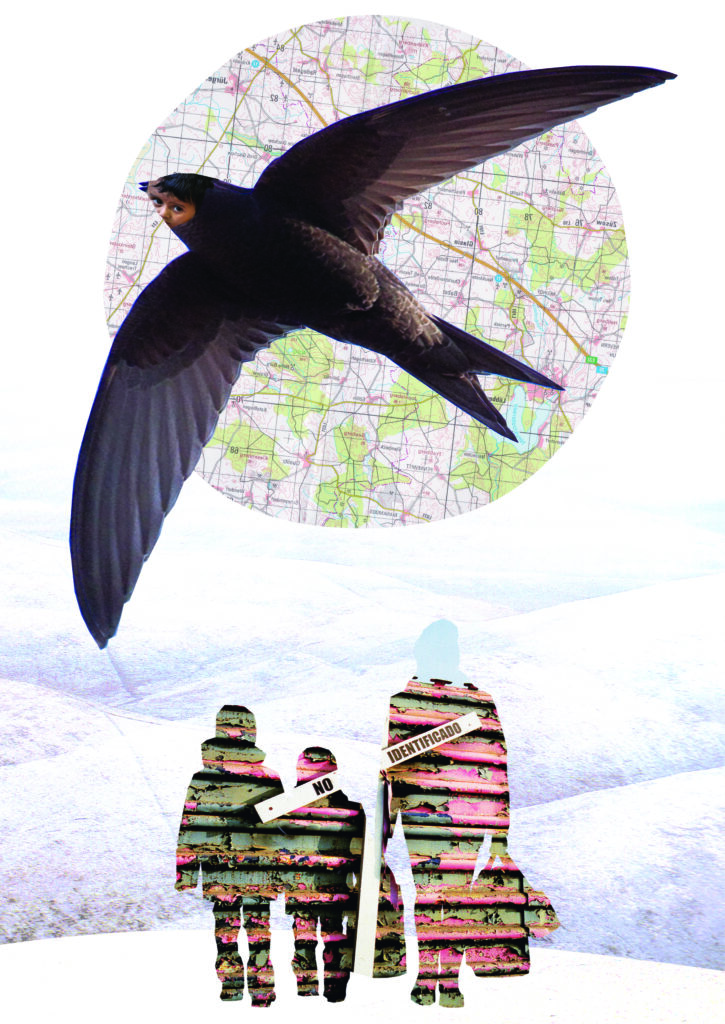
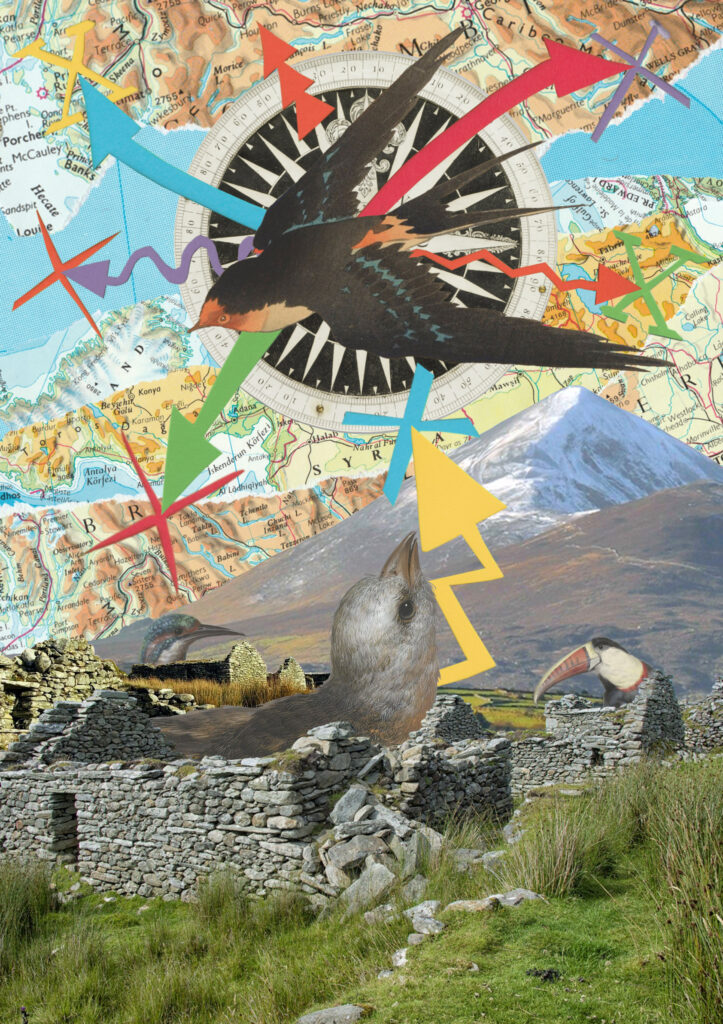
Where I decide to go is not limited by my place of birth. I have literally won the lottery of life by having an Irish passport. I am free to travel the world, like the swift in my collage. For millions of people this is not the case. Walls are built, barriers erected to keep people out. What we see reported in the media as ‘refugees’ are men, women and children stripped of their dignity, forced to make perilous journeys in search of a better, safer life. They are also stripped of their identities, reduced to numbers. The image of the adult and two children figures in my collage is cut from a wall built on the Mexican-American boarder, a section hung with a crucifix with these words on it – – NO IDENTIFICADO – unidentified.”
Domenico Goi
“I come from a small town in Northeast Italy, a land nestled between Austria, Slovenia, and the Istrian peninsula. Migration has always been part of our history; every family here knows someone who left the country searching for fortune abroad. In turn, with time, my land became an arrival destination for people fleeing unspeakable horrors, wars, and poverty.
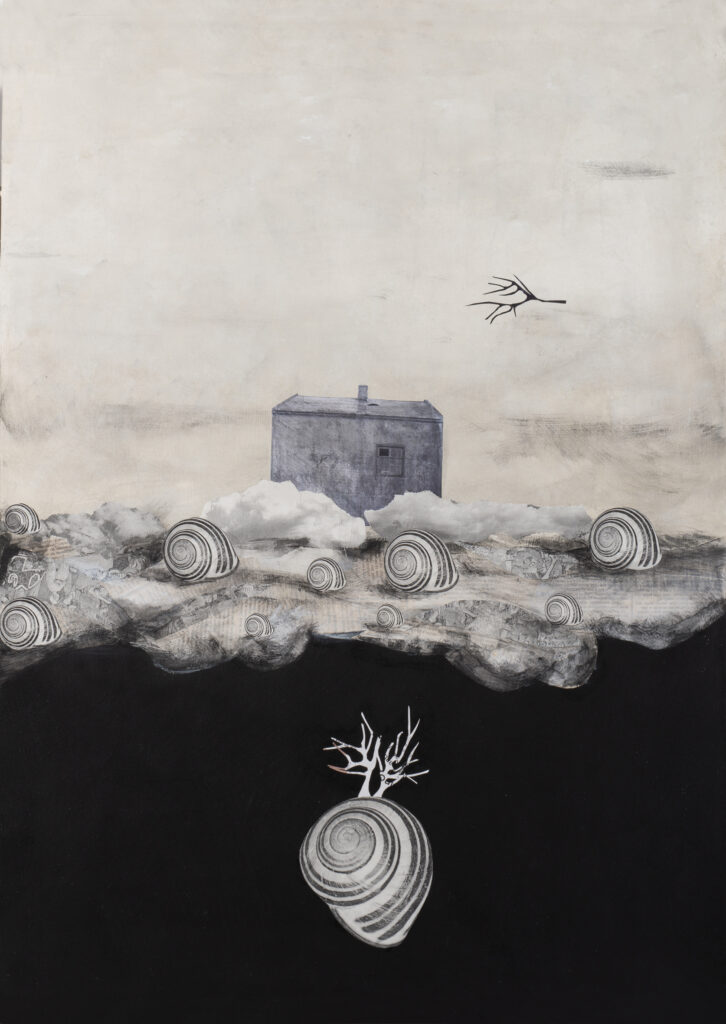
This is why I wanted to look at migration in the broadest possible sense, without clues regarding the geographical context of the tragedy; that’s one of the reasons why I chose to work with black and white only. The snail serves as a metaphor for home, but the shells here are empty, they have been abandoned since a long time. The lower section of the canvas is pitch black, a choice that underscores just how unbearable and overwhelming the migrants’ plight is. There is a handful of roots just out of the biggest snail-house, but they are floating, unmoored. At the centre, other empty snail-houses billow out with the clouds, drifting toward an unknown horizon. A “proper” house, aloof and derelict, stands in the centre, as if it were indifferent to all horrors. An empty, tin-coloured sky carries other roots searching for another land to grow in.”
Anthony D. Kelly
“Travel to the island of Achill which hangs in the dark waters of the Atlantic, off the stark and wind beaten coasts of northwest Mayo. Bring yourself along to the foot of Slievemore mountain, you will find a deserted village there.
This abandoned settlement stands as a remnant, a scar, and a memorial site; one of many strewn across this county and country. Each site is a stark reminder of times in Ireland, that due to famine, as well as social and political pressures, survival was intensely difficult for most and truly impossible for some.
Elsewhere in Mayo, evidence of potato ridges rise high up on hillsides in areas which are now devoid of settlement. These areas were once so populous, that settlers resorted to cultivating their crops at awkward altitudes for lack of space.
When you stand in these once lively landscapes now, they feel haunted somehow. Indeed, our ancestors often held “Living Wakes” with their loved ones, before going to the docks; as they knew that they would never return.
In mid-June of this year the central statistics office announced that there are now five million people living in the Republic of Ireland. Yet records show that since the 18th century between nine and ten million people born in Ireland have emigrated away. Many of my own generation chose to move abroad as the impacts of the Global Financial Crisis of 2008 sent shockwaves throughout Irish society.
We are a nation of emigrants, and we have left in many waves.
In the contemporary discourse on migration, immigration and displacement there tends to be a heavy focus on countries of arrival. This shifts our perspectives away from the realities of what might be left behind.
Yes, those who arrive in a new country are often taking flight from dire situations such as war, famine and oppression. Yet, like our ancestral loved ones who fled, they are also leaving behind loved ones, family, friends, communities, favourite meals, old stories, familiar words, much loved songs, childhood bedrooms, streets, homes, and empty nests.”
Denis Kollasch
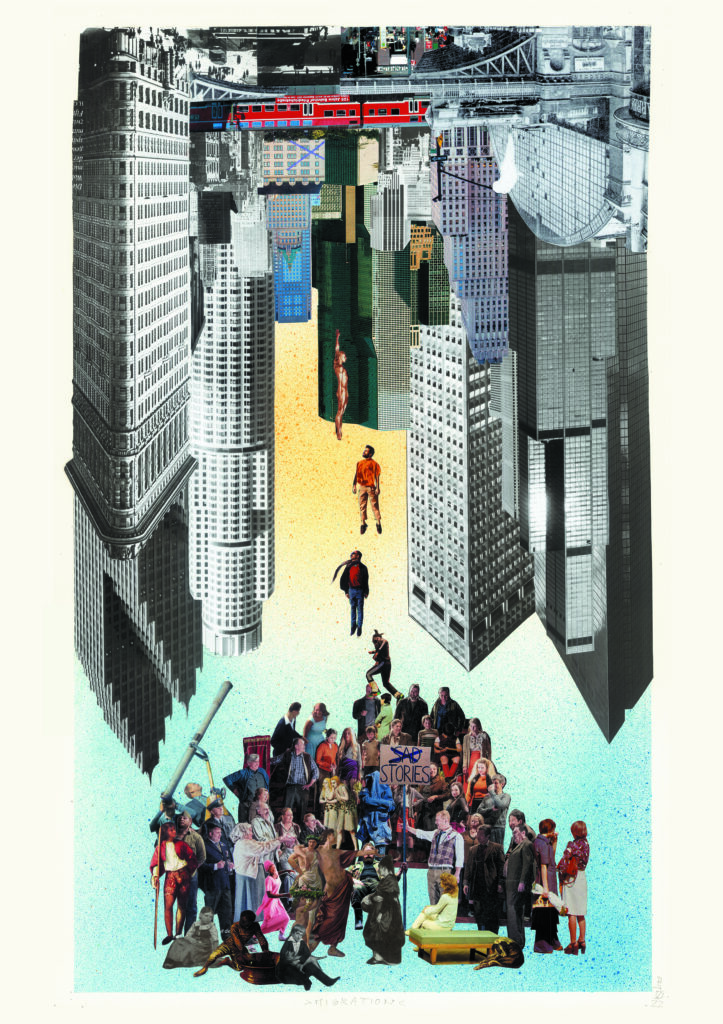
“In my work, I often deal with urban development and population. Migration of people into cities plays an essential role. There are many reasons why people move to cities. Often they hope for better living conditions and individual freedom.
The city is the place of desire and danger, of opportunity and threat. It attracts with its big city lights and repels with its stone facades. One cannot live with it and one cannot live without it. Life in the city can overwhelm with anonymity and indifference and hang over one’s head like a sword of Damocles.
With the paper collage I wanted to show this diversity of individuals and possibilities. With the rise I symbolize the hope and dreams that these people share and connect. But it can also come to the fall…”
Sherry Parker
“When I think of migration – in this context, human migration – I think of flight from FEAR…towards HOPE.
FEAR, arguably a crucial driver of migration, comprises many dimensions: loss, oppression, persecution, injustice, danger, and natural disasters, to name only a few. HOPE promises safety, security, justice, peace, freedom, acceptance, opportunity… in short, survival and a better quality of life.
In my case, the sudden and unexpected cause of my migration was FIRE. My home, my studio, my artwork, my whole life as I knew it went up in flames – totally devastated by the 2017 California wine country firestorms. We ran out of the house that night with nothing – fleeing for our lives, driving the circuitous road out through surrounding flames.
At the age of 74, I was suddenly homeless and forced to move on to “somewhere” – with no possessions, nothing. Our “migration” began with months of staying with generous friends, followed by finding a temporary rental while searching for a home. When that became virtually impossible in California after the fires, we were forced to leave our once-beloved home state of fifty years. We migrated to Santa Fe, New Mexico, a very special place we had frequented in our travels. Santa Fe proved to be a beautiful and welcoming refuge, where we now have found a new home and are rebuilding our lives.
The collage I am submitting for this exhibition is called “Ever onward”. It was created several months after the fire, thanks to my first responder collage artist friends who donated materials to begin making art again. “Ever onward”… looking back with sadness while forging onward with hope.”
Maryna Siliakova
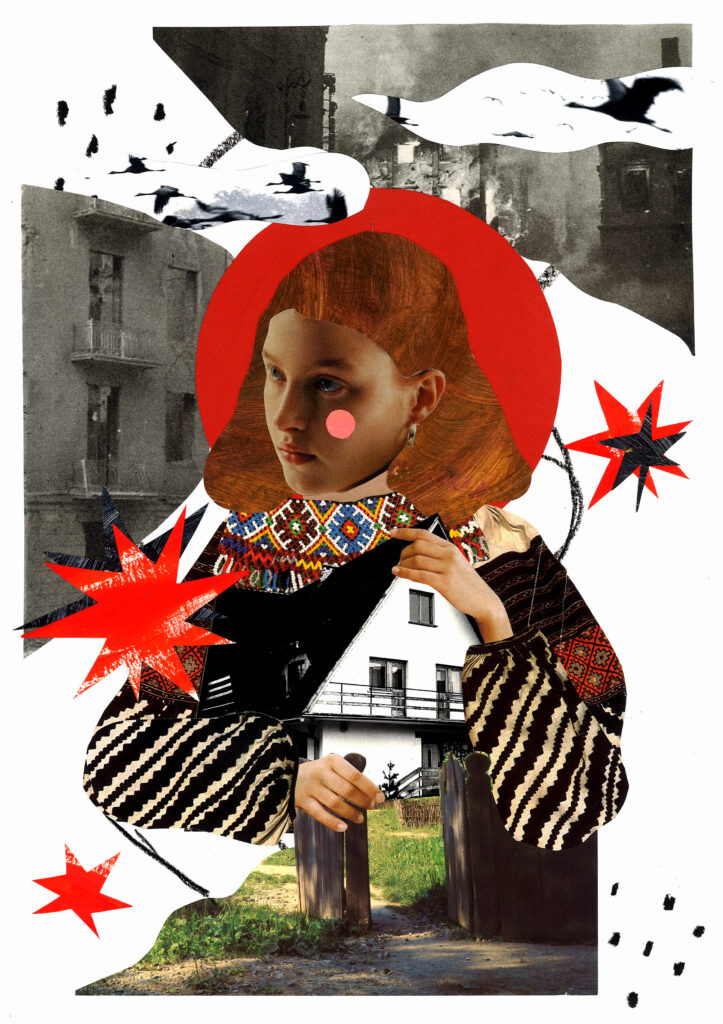
“To me, migration is a very painful and difficult concept. In my case, migration was compulsory due to the invasion of the Ukrainian Donetsk region by Russian troops in 2014. Since then, Russian tanks have been on the streets and living conditions have worsened. It has become frightening and unsafe to stay on my home territory. Leaving my home, close friends, and relatives was not an easy decision. And coming to terms with a new governmental arrangement was even harder. In 2017 my family and I lived in the wonderful city of Kharkiv, which sheltered us and gave us a sense of peace. The green parks, the old architecture are still imprinted in my heart. However, the dream of having our own home never left my parents’ minds, we longed for our hometown. We made the decision to move to Poland in 2017 in order to create better living conditions and, if possible, to earn money for a new home in Ukraine. Unfortunately, the occupation of the Donetsk region lasted a long time and gave no hope of returning.
At the moment I live in Poland. I am surrounded by peace, I have all the necessary things to live, and I am developing myself in my profession. However, on February 24, 2022, a real and large-scale war began. Russia invaded the territory of a sovereign state – my home country Ukraine. Since then, my heart has been at a standstill. Ukrainians do not have a peaceful life as before, every hour someone dies and many were forced to leave their home. In my work, I have tried to portray the peace of mind we had (having a home, a life in our land) and at the same time what we are losing now because of this war. Many Ukrainians have already lost their home, some are already living in another country, even though they didn’t plan to. And some simply do not have the opportunity to leave because of the presence of Russian troops. Forced departure and migration because of the war is the worst thing that can happen.
I believe that victory is on the side of light and good. Peace and tranquility will surely come. Victory for Ukraine. Stand with Ukraine.”
Silvio Severino
“When I started to create the work for the Migration project, I began to reflect on my own experience of migration. I am of Polish descent and a second-generation Italian immigrant in southern Brazil. I started my own journey and moved to Europe at the age when my father moved from Calabria to Brazil.
I can say that migration is in my DNA!!
Since I am in Europe, I have lived in many places. It has been a very enriching and fulfilling experience, which has helped me to get a better understanding of the world. Nonetheless, migrating has not always been easy.
My story is not as tragic as the stories of many people who were forced to migrate by war or persecution, but it certainly has its ups and downs. The process of adaptation to a different culture and language can make you feel out of place. The feeling of displacement and alienation is constant. In some ways, you are affected by an identity crisis: since you left your homeland, you are no longer part of your initial culture, something is lost, and you certainly do not belong entirely to the new one. I was lucky to meet wonderful people who have helped me in my journey so far! Overall, this experience has been very positive.
The collage I have created reflects all those feelings. The journey, the sensation of alienation and uncertainty, but also the possibilities of a new life. It is also an artistic representation of what migration can mean in the future and how nature can help us. My work is open to interpretation.”
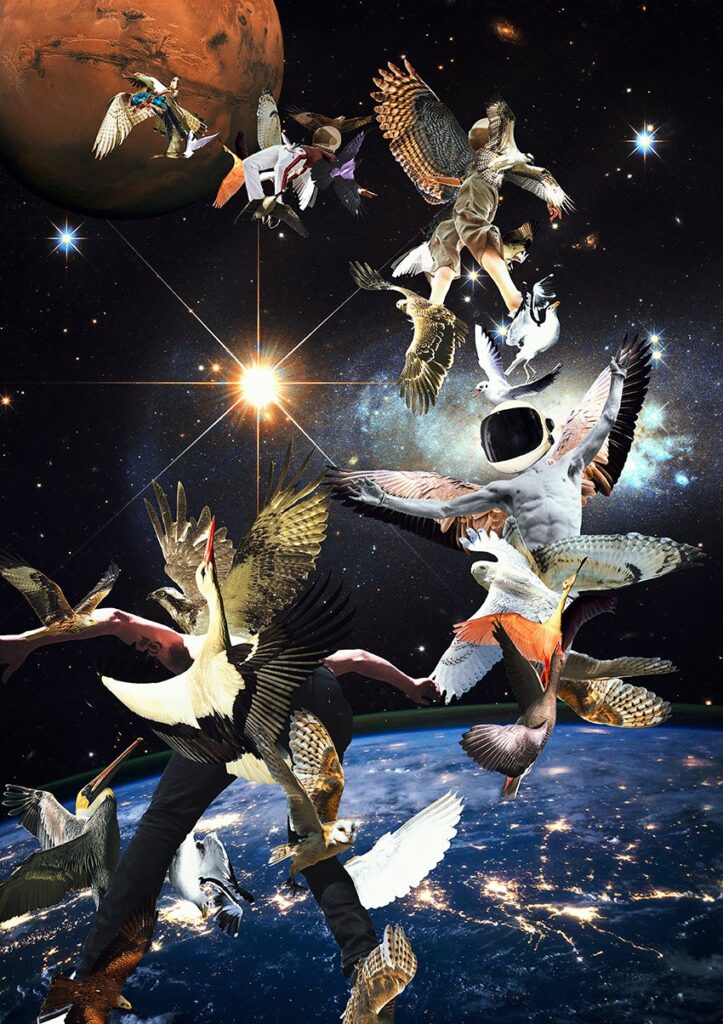
Steve Tierney
“My story of migration is one of choice and comes from a position of privilege that I fully acknowledge and understand. I’m very lucky to be able to move freely around the world. Not only due to my flexible working situation, but also, being an Australian citizen allows me access through most countries in the world with little problem. I never lose sight of or take for granted the difference between my own journey and that of millions of people who don’t have a choice, and who often risk their lives in order to either move country or not.
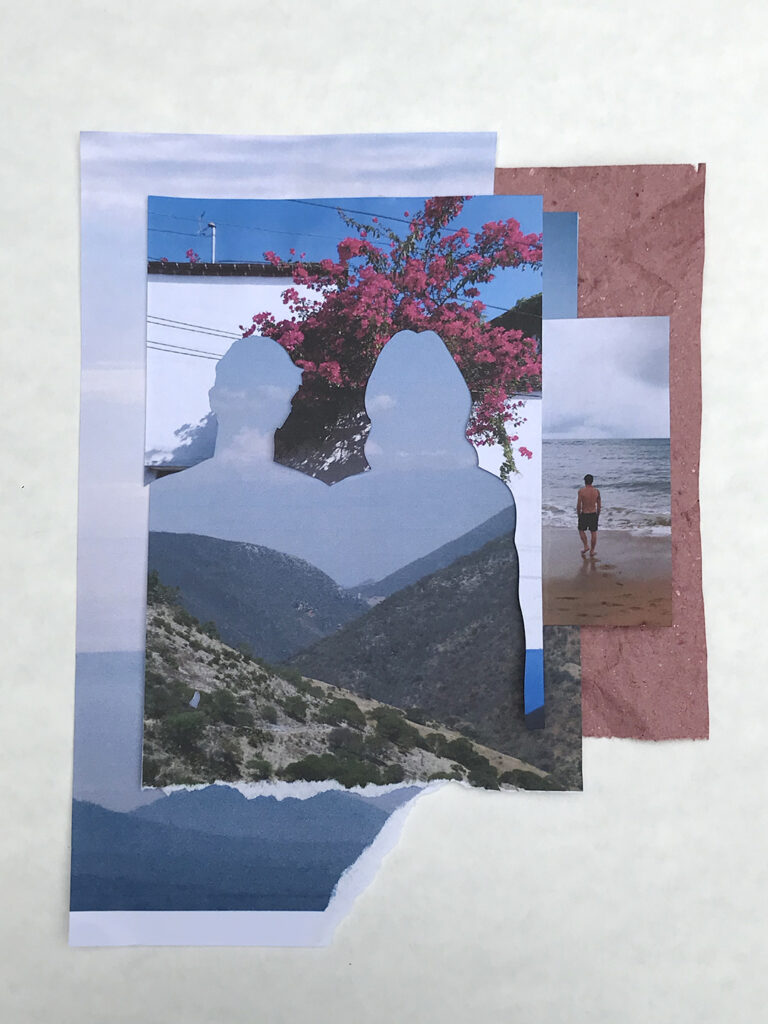
The artwork I created for this exhibition is a self-portrait titled Same Difference. It’s about self-reflection, identity and freedom. The two silhouette shapes are cut from photographs of my own profile 10 years apart and express the idea that I feel like I exist in two places, like I almost have two lives.
Since 2011 I’ve lived outside of Australia and spent most of that time living in Oaxaca in southern Mexico. A magical place that’s provided me with unlimited inspiration for my art and for my life in general. I’ve kept my Australian citizenship, and travel there regularly to see family. However, I’ve always felt able to express myself more creatively and freely in Mexico.
When I stand on a beach in Oaxaca and look out to sea, I’m aware that I’m looking directly back at Sydney, where I’m from. The same goes for when I’m in Australia looking toward Mexico. I have a need to look outward in order to find inspiration and challenge myself, but I also feel a strong desire to look inside myself and back toward home to the things that comfort me and give me my identity.”
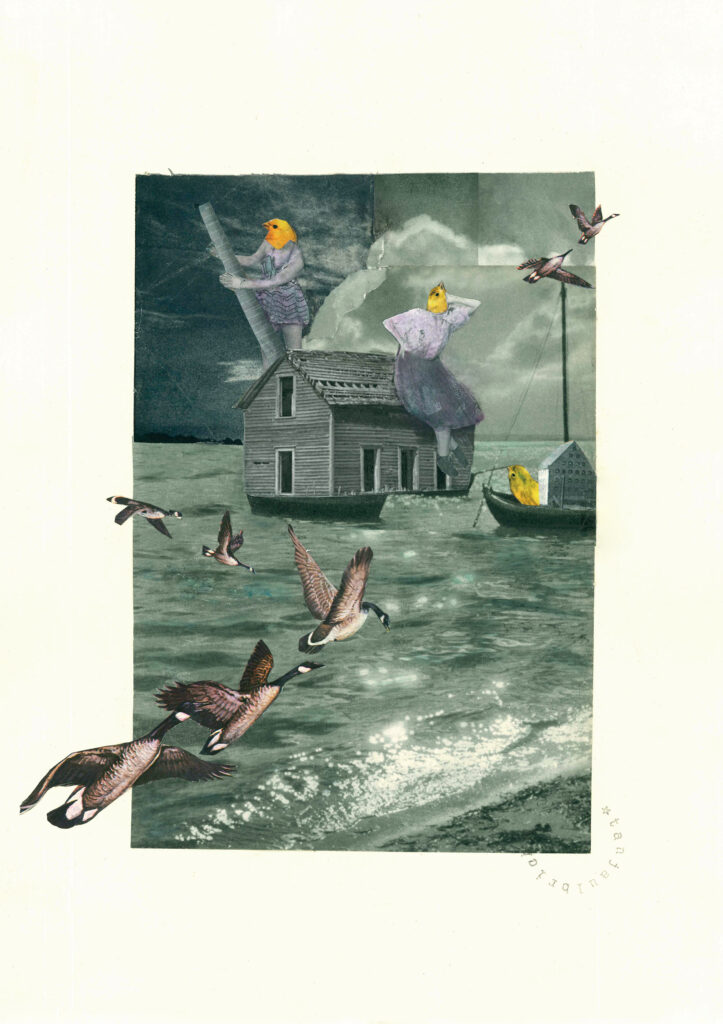
Tanja Ulbrich
“Migration is an emotional journey. There are many reasons why people migrate, what we all have in common are the feelings it provokes. Sometimes we feel fear, anger, sadness and other times happiness, surprise and hope. I am fascinated by the symbolism of natural elements and how they connect to our inner world of emotions. Are we navigating, drifting along or drowning . Those are topics all migrants face.
Hope is a feeling that is not unlike flying, soaring above, spotting new horizons and creating a new nesting place. I have had the chance to live in 3 countries, spending the last 22 years in Spain. My experience and my work with migrant people has taught me that although we are diverse, we all feel. Emotions are universal. We are all searching for a sense of belonging, a home to feel safe in. If we could take a moment to imagine ourselves in someone else´s situation and imagine what they could be feeling, we might find greater understanding and connection to others. It takes a lot of strength to embark on a new journey, leaving behind our life as we knew it, our country, our family,our language and perhaps even our identity.
Migration is similar to collage, it´s also about the adventure of going to new places, finding the right elements, combining them and constructing a new picture. There is something exhilirating about repurposing old materials and giving them a new opportunity. My collages always have raw, unedited, imperfect aspects because I am intrigued by authenticity and the uniqueness of the present moment, as is. Each collage is like life, a unique mash up of of elements, figures and backgrounds full of possibilities.”